How teaching a neural network the equations of physics, instead of just showing it more data, is reshaping engineering simulation and creating one of the most sought-after hybrid skill sets in the industry
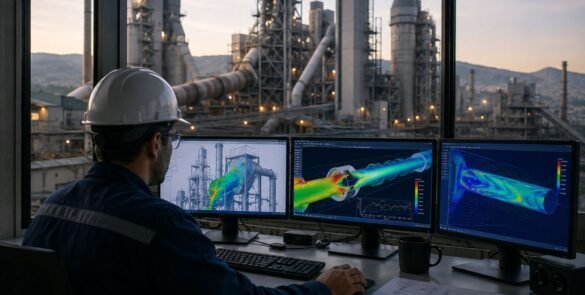
Ask a structural engineer what a neural network knows about beams, and the honest answer is usually: nothing, until you show it thousands of examples. Ask a fluid dynamicist how long a genuinely new CFD run takes on an unfamiliar geometry, and the honest answer is usually: hours, sometimes days, no matter how many similar cases have been run before. For most of the last decade, engineering simulation and machine learning solved different problems in different ways, and mostly lived in different departments. One camp had the physics but not the speed. The other had the speed but not the physics.
Physics-Informed Neural Networks (PINNs) exist because a small group of researchers refused to accept that trade-off. Instead of training a network purely on data, or solving a differential equation purely with a mesh, they asked a more interesting question: what happens if the network is required to obey the governing equations of physics as a condition of learning at all?
What a PINN Actually Is
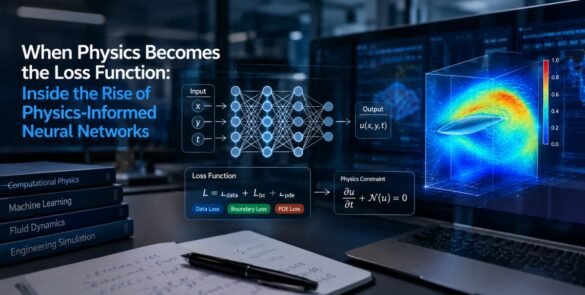
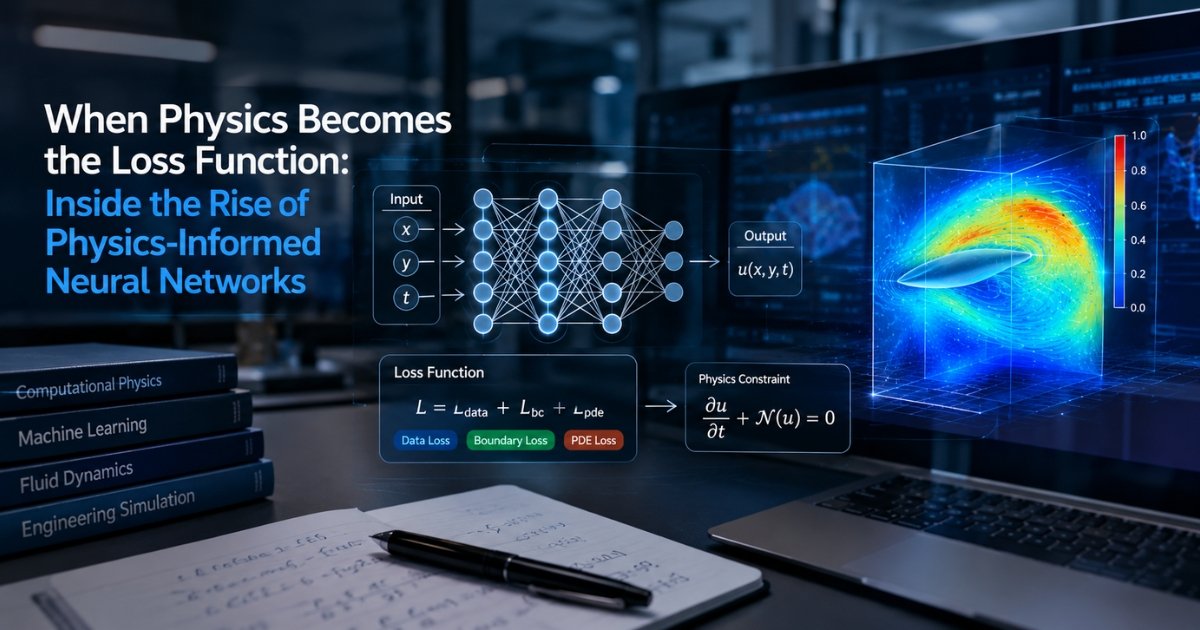
A conventional neural network learns by minimising the gap between its predictions and a set of labelled training examples; the more data in, the better the predictions out. A Physics-Informed Neural Network is trained differently. Its loss function is a weighted combination of three things: how well it matches any available data, how well it satisfies the boundary and initial conditions of the problem, and, this is the part that gives PINNs their name, how well it satisfies the governing partial differential equation (PDE) itself, evaluated as a residual at points scattered across the domain.
That last term is where the physics gets embedded. Because modern deep learning frameworks compute exact derivatives of a network’s output with respect to its inputs through automatic differentiation, a PINN can calculate how its own predicted solution changes in space and time, plug those derivatives into the governing equation, and penalise itself whenever the equation is not satisfied. The network is never told the answer directly. It’s told the rule the answer has to obey, and it learns a continuous function that respects that rule everywhere in the domain.
This idea reached its modern, widely cited form in a 2019 paper by Maziar Raissi, Paris Perdikaris, and George Karniadakis, which framed PINNs as a general deep learning approach for both forward and inverse problems involving nonlinear PDEs. The formulation was elegant and general enough to be picked up almost immediately across fluid dynamics, structural mechanics, heat transfer, and beyond.
In practice, a typical PINN architecture is modest by deep learning standards, often with 4 to 8 hidden layers and 20 to 50 neurons each, trained with a combination of the Adam optimiser for initial convergence and L-BFGS for fine-tuning, usually on GPU hardware. The elegance is not in the size of the network. It is in what the loss function must respect.
Where PINNs Actually Win?
PINNs are often oversold as a blanket replacement for traditional numerical methods, which is not quite true. For a standard, well-posed forward problem with known geometry, boundary conditions, and material properties, a mature Finite Element or CFD solver is still generally faster to set up, faster to solve, and more accurate than training a PINN from scratch. PINN training itself is often slower and more finicky than a conventional solver run.
PINNs pull ahead in the class of problems traditional solvers struggle with: high-dimensional parameter spaces, irregular or evolving geometries that are painful to remesh, and, most importantly, inverse problems, where the goal is not to predict an outcome from known conditions but to infer unknown physical properties or boundary conditions from sparse, noisy, real-world measurements. Because a PINN can blend observed data with physical constraints inside the same loss function, it’s naturally suited to reconciling what a handful of sensors actually measured with what the underlying physics says should be happening everywhere else. That’s precisely the kind of data-assimilation problem that comes up constantly in structural health monitoring, non-destructive testing, medical imaging, and geophysical exploration.
The other place PINNs earn their keep is after training is finished. Once a network has learned to satisfy a governing equation across a family of related conditions, evaluating it for a new input is often close to instantaneous: a single forward pass instead of a fresh, hours-long solve. That upfront training cost, traded for near-instant inference afterwards, is the real mechanism behind the “hours to seconds” claims attached to physics-informed AI tools today. It’s not that the physics got solved faster in an absolute sense. It’s that the expensive part moved earlier and got paid once instead of every single time an engineer needs an answer.
Why This Is Trending Now?
PINNs are not new; the core idea has existed since 2019, and Gartner had already flagged physics-informed approaches on its Hype Cycle for Emerging Technologies by 2021. The change is that the surrounding ecosystem has finally caught up to the idea on several fronts at once.
The academic literature has grown almost exponentially since the original paper, with thousands of PINN-related papers now published annually across fluid dynamics, materials science, biomedicine, and climate modelling. Compute that used to be exotic is now routine: NVIDIA’s A100 and H100 GPUs are standard training hardware for these models, and NVIDIA has built and open-sourced an entire framework, PhysicsNeMo, specifically to lower the barrier for training physics-informed and physics-based AI models, complete with reference architectures for computational fluid dynamics, structural analysis, and electromagnetics. In June 2026, NVIDIA went a step further with Cosmos 3, a foundation model for physical AI that companies can fine-tune for their own domain-specific simulation tasks rather than training from a blank slate, a shift that meaningfully lowers the cost of entry for mid-sized engineering teams who couldn’t previously justify building this capability in-house.
The commercial signals are just as loud. Ansys now ships SimAI with production-grade accuracy claims within one to two per cent of high-fidelity reference simulations for CFD and structural problems, and Siemens has integrated comparable physics-AI capability into Simcenter. PhysicsX, a company built specifically around AI-accelerated engineering simulation, closed a $300 million Series C in mid-2026 at a $2.4 billion valuation, a scale of investment that simply didn’t exist in this space a few years earlier. Analysts now size the broader physics-AI engineering simulation software market at roughly $15 billion in 2025, projected to reach $41.6 billion by 2034. None of that spending happens because a technique is academically interesting; it happens because engineering teams are demonstrably getting design-space exploration, digital twins, and inverse-problem capability that older tools couldn’t deliver at any price.
The New Job on the Org Chart
All of that adoption has to be built and maintained by someone who doesn’t fit neatly into either of the job descriptions that used to exist. A traditional CAE engineer knows the physics and the solver but not necessarily PyTorch or automatic differentiation. A traditional machine learning engineer knows the training pipeline but not necessarily what a boundary condition is. PINNs sit exactly in that overlap, and hiring has followed it into existence as a role of its own, usually under the banner of Scientific Machine Learning, or SciML.
The evidence is concrete. As of mid-2026, job boards list several hundred openings explicitly referencing physics-informed neural networks, spanning aerospace, semiconductor manufacturing, energy, and defence. Compensation reflects the scarcity of the combination: research-scientist-level PINN roles have posted salary bands from roughly $170,000 to $250,000 in the United States, and some AI-native engineering firms hire senior researchers whose entire job is advancing physics-informed modelling for real-world systems. What every posting has in common is not a specific tool; it is a candidate who can move fluently between a PDE on a whiteboard and a training loop in PyTorch, JAX, or TensorFlow.
That combination is currently concentrated where deep physics expertise and serious compute already sit in the same building: energy, semiconductors, aerospace. For an engineer already fluent in fluid dynamics, structural mechanics, or thermal systems, picking up the machine learning half is one of the highest-leverage career moves available right now, simply because it’s one of the few skill combinations the market is actively short of.
The Way Forward
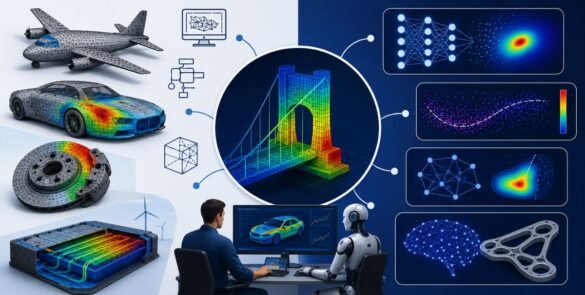
None of this means PINNs are on a trajectory to replace Finite Element Analysis, Computational Fluid Dynamics, or any other established numerical method, and the more mature commentary in this space is careful to say so. Whatever is happening, it is closer to a merger than a takeover: hybrid PINN-FEA workflows, neural surrogate models trained on traditional solver output, and physics-informed approaches applied specifically to the inverse problems that classical methods have always found hardest.
For engineering teams, the practical takeaway is less about picking a side and more about recognising where each tool actually earns its place: fast, well-validated solvers for standard forward problems, and physics-informed learning for the messy, data-sparse, inverse, and high-dimensional problems that used to be genuinely intractable. For individual engineers, the takeaway is more direct: the ability to speak both languages, physics and machine learning, fluently enough to know which one a given problem actually calls for, is quickly becoming one of the more valuable, and currently scarcer, capabilities in the field.
References
[1] M. Raissi, P. Perdikaris & G.E. Karniadakis, “Physics-informed neural networks: A deep learning framework for solving forward and inverse problems involving nonlinear partial differential equations,” Journal of Computational Physics, vol. 378, pp. 686-707, 2019.
[2] Neural Concept, “Physics Informed Neural Networks in Engineering,” 2026.
[3] Gartner Hype Cycle for Emerging Technologies, 2021.
[4] Google Scholar publication trend analysis, as referenced in industry PINN adoption surveys, 2025-2026.
[5] NVIDIA, “Physics-Informed Machine Learning Platform NVIDIA PhysicsNeMo,” NVIDIA Developer Blog / PhysicsNeMo documentation, 2026.
[6] “Physics AI Engineering Simulation Software Market Research Report,” 2026.
[7] Physics AI Engineering Simulation Software Market Research Report, 2026.
[8] PhysicsX Newsroom, “PhysicsX Announces Advancement to Open Standards for Physics AI, Powered by NVIDIA,” March 2026.
[9] Physics AI Engineering Simulation Software Market Research Report, 2026.
[10] Indeed.com job listings, “Physics Informed Neural Network Jobs,” accessed 2026.
[11] ZipRecruiter and Indeed salary and job listing data; LinkedIn job posting, OriGen.AI, “Physics-Informed Neural Networks Researcher,” accessed 2026.
[12] Neural Concept, “Physics-Informed Neural Networks in Engineering,” 2026.