Lithium–sulfur (Li–S) batteries have long promised higher energy density than conventional lithium-ion cells—potentially double or more—thanks to sulfur’s high theoretical capacity and abundance. Yet a stubborn obstacle has kept them from widespread commercial use: the “polysulfide shuttle.” During cycling, soluble lithium polysulfides form, migrate between electrodes, cause active material loss, accelerate capacity fade, and slow the conversion reactions needed for efficient charge and discharge.
A research team led by scientists at Tohoku University in Japan, working with collaborators at Lanzhou University and SRM University AP, has developed a molecularly engineered solution that meaningfully advances the technology. They created a covalent organic framework (COF)–graphene hybrid interlayer that actively manages polysulfides rather than merely blocking them.
Designing a Multifunctional Interface
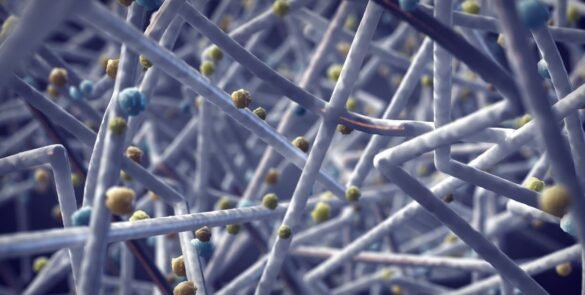
Covalent organic frameworks are porous, crystalline materials built from organic building blocks linked by strong covalent bonds. Their structures can be tuned at the molecular level, making them attractive for selective chemical interactions. The team designed a new COF, named TUS-44, incorporating tetrathiafulvalene (TTF) units and crown-ether moieties. These provide complementary binding sites—imine nitrogen, crown-ether oxygen, and sulfur-rich TTF centers—that chemically trap and interact with lithium polysulfides.
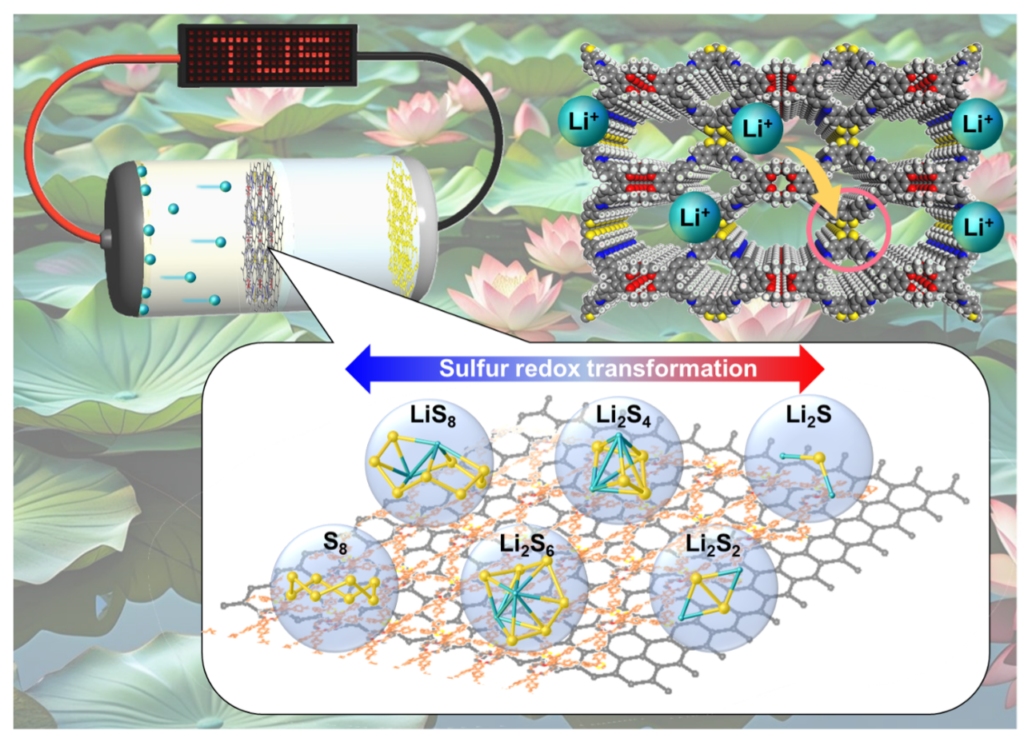
Schematic of the developed COF-graphene interfacial layer as incorporated in the working concept of the lithium-sulfur battery (Figure taken from https://www.tohoku.ac.jp/en/press/a_cof_graphene_hybrid_opens_new_horizons_for_lithium_sulfur_batteries.html)
To overcome the typically modest electronic conductivity of pure COFs, the researchers integrated TUS-44 with highly conductive graphene, forming a hybrid layer designated TUS-44@G. This thin, functional coating is applied to a conventional polypropylene separator, creating an interfacial layer between the sulfur cathode and lithium anode. The hybrid combines chemical trapping, facilitated lithium-ion transport, rapid electron transfer via the graphene network, and promotion of sulfur conversion kinetics in a single lightweight platform.
As Saikat Das, Junior Associate Professor at Tohoku University’s Institute of Multidisciplinary Research for Advanced Materials, explained: the goal was an interlayer that “does not simply block polysulfides, but actively manages their reaction pathway.” By coupling crown-ether and tetrathiafulvalene chemistry in an ordered COF with graphene, the team produced a cooperative interface that anchors, redistributes, and converts sulfur species more efficiently.
Standout battery performanceLab-scale cells incorporating the TUS-44@G interlayer delivered impressive results:
- A high reversible capacity of 1455.7 mAh g⁻¹ at 0.2 A g⁻¹.
- Strong rate capability, retaining 773 mAh g⁻¹ even at a demanding 10 A g⁻¹.
- Exceptional long-term durability, with only 0.034% capacity fading per cycle over 1,000 cycles at 5 A g⁻¹.
These metrics indicate effective suppression of the shuttle effect alongside accelerated electrochemical conversion of sulfur species.
The approach also scaled to a more practical format. A Li–S pouch cell using the same interlayer achieved an initial energy density of approximately 674 Wh kg⁻¹ at 0.05 A g⁻¹ (with a sulfur loading of about 44.6 mg). This figure substantially exceeds typical commercial lithium-ion energy densities and underscores the hybrid’s potential for higher-energy applications.
Why This Matters
Li–S batteries could enable longer-range electric vehicles, lighter portable electronics, and more efficient grid storage if durability and rate performance improve. Previous strategies often focused on physical barriers or simple adsorbents. The TUS-44@G design stands out by uniting selective chemical interaction, electronic conductivity, and catalytic promotion of conversion reactions within one molecularly precise interlayer.
The work, published in the journal Small, reflects international collaboration and builds on growing interest in framework materials for energy storage. Challenges remain for full commercialization—scaling synthesis, optimizing cost, ensuring compatibility with lean-electrolyte and high-loading conditions, and validating safety over extended real-world use. Still, the results demonstrate that carefully engineered organic–inorganic hybrid interfaces can address core limitations of Li–S chemistry.
Japan’s contribution through Tohoku University highlights continued innovation in next-generation battery materials. As researchers refine these molecular platforms, high-performance lithium–sulfur batteries move closer from laboratory promise toward practical, high-energy storage solutions.