
More results...
More results...
Vehicle thermal management plays a critical role in passenger comfort, component reliability, energy consumption, EV driving range, and overall vehicle performance. Cabin HVAC systems, radiators, condensers, fans, ducts, heat exchangers, coolant loops, underhood airflow, battery cooling, motor cooling, and power electronics cooling must work together efficiently under changing operating and ambient conditions.
Vehicle Thermal Management & HVAC helps automotive and electric mobility teams evaluate how heat, airflow, coolant flow, and system layout affect cabin comfort, component temperatures, and energy efficiency. By using simulation-led engineering, Experiqs helps improve HVAC performance, optimize cooling systems, reduce energy demand, and support better thermal reliability.
Experiqs provides Vehicle Thermal Management & HVAC services for automotive OEMs, EV manufacturers, mobility startups, HVAC system developers, thermal component suppliers, and engineering teams. We use CFD simulation, thermal analysis, cabin airflow modelling, coolant loop studies, underhood airflow analysis, heat exchanger performance evaluation, and system-level thermal optimization to improve passenger comfort and vehicle efficiency.
Modern vehicles operate across wide temperature ranges, driving conditions, traffic scenarios, charging events, and climate requirements. Thermal systems must provide cabin comfort while also protecting critical components such as batteries, motors, inverters, converters, onboard chargers, radiators, condensers, compressors, and electronic control units.
In electric vehicles, HVAC and cooling energy demand directly affects driving range. Heating, cooling, defrost, demist, and thermal conditioning can consume significant energy, especially in extreme ambient conditions. Poor HVAC or cooling system design can reduce passenger comfort, increase energy use, delay defrost performance, create uneven cabin temperature, and limit EV range.
Underhood and front-end cooling airflow also affect thermal reliability. Poor airflow through radiators, condensers, fans, ducts, or heat exchangers can create high component temperatures, recirculation, pressure losses, and cooling limitations.
Simulation-led vehicle thermal analysis helps visualize airflow, temperature distribution, coolant flow, heat transfer, and system-level energy demand before prototype testing. Experiqs helps automotive teams improve comfort, cooling performance, and EV efficiency with practical simulation-backed recommendations.
We simulate airflow, temperature distribution, defrost, demist, and HVAC performance inside vehicle cabins.
Our analysis helps assess:
This helps improve occupant comfort and HVAC system effectiveness.

We study radiators, condensers, fans, ducts, heat exchangers, coolant loops, and underhood airflow to improve component cooling.
We help evaluate:
This helps improve thermal reliability and cooling efficiency across vehicle systems.
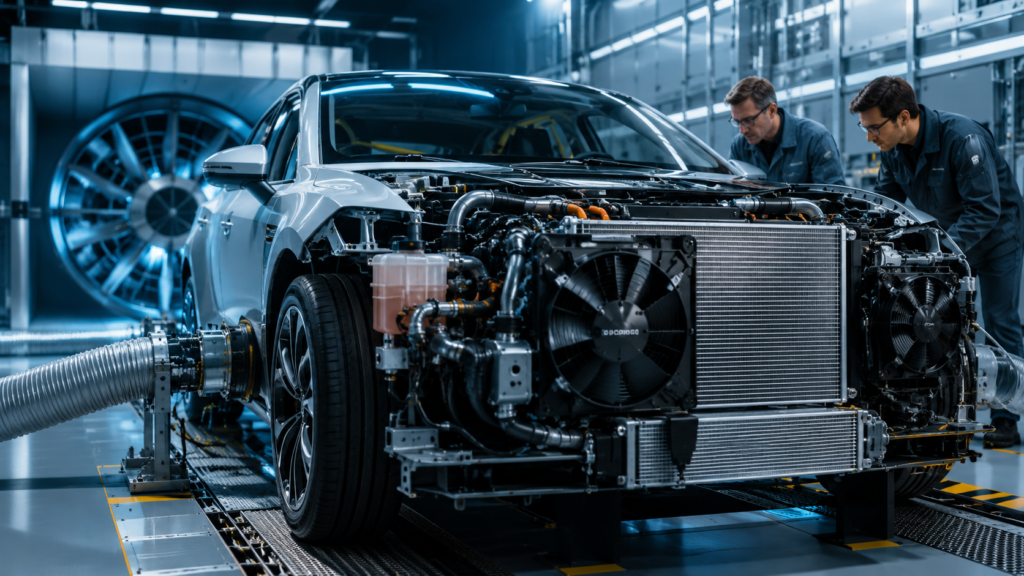
HVAC and cooling systems can significantly influence vehicle energy demand, especially in EVs.
Experiqs helps reduce:
This helps improve overall vehicle efficiency and extend EV driving range.

Front-end airflow strongly affects radiator, condenser, fan, and underhood cooling performance.
We analyze:
This helps improve heat rejection and prevent thermal performance limitations.

Coolant circuits must deliver stable heat transfer while managing pressure drop, pump demand, and temperature control.
We help optimize:
This helps improve component cooling and system-level thermal performance.

Electric vehicles require close integration between cabin HVAC, battery cooling, motor cooling, power electronics cooling, and thermal control strategies.
We help evaluate:
This helps improve EV range, safety, comfort, and powertrain reliability.

Experiqs helps automotive OEMs, EV manufacturers, mobility startups, and thermal system teams address vehicle thermal management challenges, including:
Enhance cabin airflow, temperature uniformity, HVAC performance, defrost, and demist effectiveness.
Improve radiator, condenser, heat exchanger, underhood, coolant loop, and thermal system performance.
Reduce HVAC and cooling energy demand to support better electric vehicle efficiency and driving range.
Identify overheating risks, airflow limitations, coolant maldistribution, and heat rejection constraints early.
Use CFD and thermal simulation to compare HVAC, cooling, and thermal system designs before prototype testing.
Understand how cabin HVAC, battery cooling, motor cooling, power electronics cooling, and vehicle airflow interact.
Experiqs combines CFD simulation, thermal engineering, HVAC airflow analysis, heat transfer modelling, coolant loop studies, and vehicle system-level optimization to improve automotive and EV thermal performance.
Our strength lies in connecting cabin comfort, component cooling, airflow management, coolant flow, and energy efficiency into one engineering view. We help clients understand where thermal losses occur, why cooling becomes ineffective, and how thermal systems can be optimized for comfort, reliability, and EV range.
By validating vehicle thermal behaviour virtually, Experiqs helps automotive teams reduce prototype iterations, improve thermal reliability, reduce HVAC energy demand, and make better engineering decisions before physical testing.
Optimize cabin HVAC, coolant loops, radiator airflow, underhood cooling, heat exchanger performance, and EV thermal system integration with Experiqs’ Vehicle Thermal Management & HVAC services.
Talk to our experts to evaluate your vehicle thermal system and identify practical opportunities for better comfort, stronger cooling performance, and improved energy efficiency.
Partner with Experiqs to transform complex ideas into validated, industry-ready engineering solutions
Discover how to partner with Experiqs and get started quickly
Whether you’re exploring a new R&D initiative, seeking advanced simulations, planning experimental validation, or evaluating product feasibility—our experts are ready to assist you.
