
More results...
More results...
Oil and gas facilities contain complex piping, process systems, pumps, compressors, valves, manifolds, separators, scrubbers, flare systems, and rotating equipment that operate under high pressure, high flow velocity, multiphase flow, cyclic loading, and transient operating conditions.
These operating conditions can create vibration, pulsation, resonance, flow-induced vibration, acoustic noise, structural fatigue, and dynamic response issues. If not identified early, these problems can lead to pipe failures, equipment damage, leakage, unplanned shutdowns, safety risks, and reduced asset life.
Experiqs provides Noise, Vibration & Flow-Induced Vibration Analysis services for upstream, midstream, downstream, offshore, refinery, petrochemical, LNG, and process industry assets. We use CFD simulation, unsteady flow analysis, pulsation studies, structural dynamics, FEA, acoustic assessment, and vibration risk evaluation to help oil and gas teams improve reliability, reduce noise, and protect critical equipment.
Noise and vibration issues in oil and gas systems are often caused by the interaction between fluid flow, pressure fluctuations, rotating equipment, structural supports, and system geometry. High-velocity flow, turbulence, slug flow, multiphase flow, valve throttling, compressor pulsation, pump operation, and sudden flow changes can all generate dynamic forces.
When these forces interact with piping, supports, vessels, valves, equipment frames, or structural natural frequencies, they can create resonance and fatigue damage. Even small pressure pulsations or flow disturbances can become serious if they occur repeatedly over time.
Flow-induced vibration is especially important in piping networks, process systems, risers, flowlines, valves, bends, tees, and high-velocity regions. Pulsation can affect compressors, pumps, piping systems, and process equipment by creating fluctuating loads and unstable operating behaviour. Noise can also indicate inefficient flow behaviour, turbulence, pressure fluctuations, or acoustic resonance.
Simulation-led analysis helps identify vibration sources, pressure fluctuation patterns, acoustic behaviour, structural response, and fatigue-prone areas before they cause operational failure. Experiqs helps oil and gas teams reduce reliability risks by connecting flow behaviour with dynamic structural response.
We identify vibration risks caused by turbulence, multiphase flow, high-velocity operation, and unstable internal flow behaviour.
Our analysis helps assess:
This helps reduce vibration-related reliability risks in piping, process equipment, and flow control systems.

Pressure fluctuations can create dynamic loading in piping and process systems, especially near compressors, pumps, valves, and high-energy flow equipment.
We help evaluate:
This helps reduce pulsation-related damage and improve system reliability.

Operational noise can be caused by flow turbulence, pressure pulsation, valve throttling, rotating machinery, acoustic resonance, and high-velocity gas or liquid flow.
Experiqs supports noise reduction by evaluating:
This helps reduce operational noise while maintaining process performance.

Resonance can occur when excitation frequencies from flow, rotating machinery, or pulsation match the natural frequencies of piping, supports, or equipment structures.
We help assess:
This helps prevent excessive vibration, fatigue cracking, and structural damage.
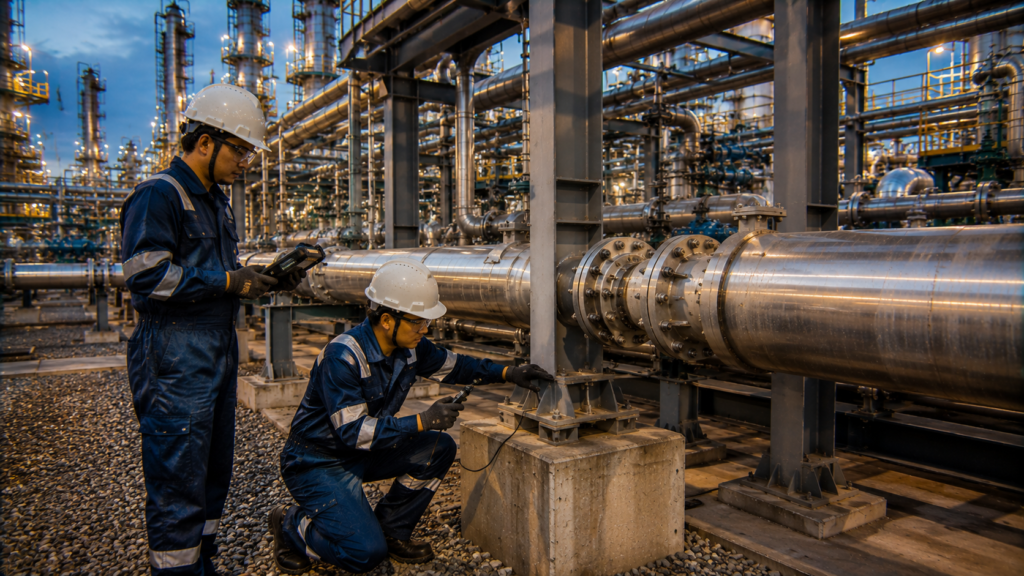
Piping systems in oil and gas facilities are exposed to pressure fluctuations, flow forces, thermal movement, support conditions, and operating transients.
We analyze:
This helps improve piping integrity and reduce failure risk.
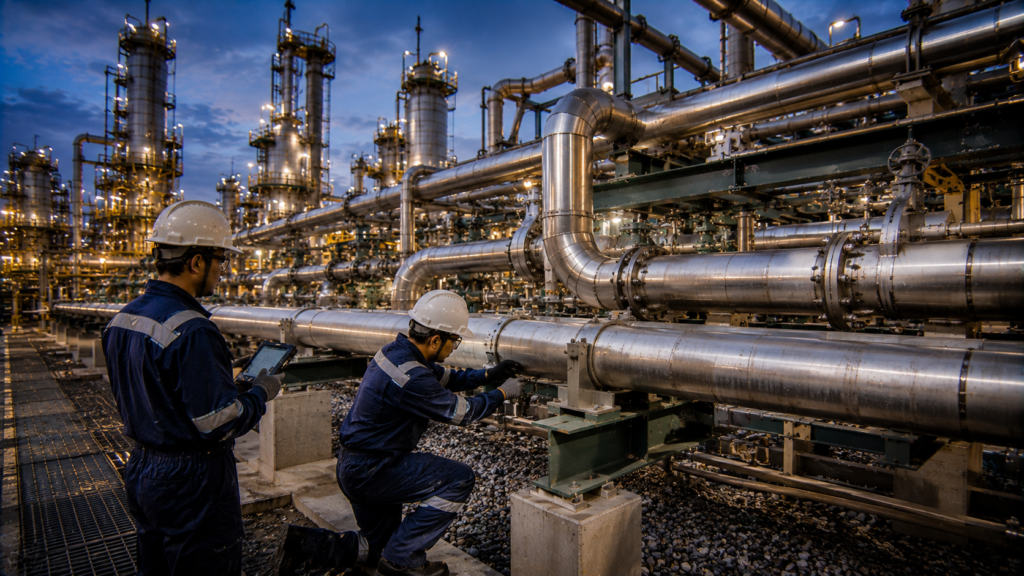
Repeated vibration and pulsation can cause fatigue damage even when stress levels appear acceptable under static conditions.
We help identify:
This helps support asset integrity, inspection planning, and long-term equipment life.

Experiqs helps oil and gas operators, EPC teams, refinery teams, offshore teams, and equipment manufacturers address vibration and noise challenges, including:
Identify flow-induced vibration, resonance, and dynamic response issues before they damage equipment or piping.
Evaluate pressure fluctuations and dynamic loads to reduce fatigue and reliability risks.
Identify noise sources and support design changes that reduce operational noise while maintaining performance.
Understand how unsteady flow, pressure pulsation, and vibration affect critical oil and gas assets.
Identify vibration-sensitive and fatigue-prone locations for improved inspection and maintenance planning.
Use simulation-led analysis to understand whether vibration is caused by flow behaviour, pulsation, resonance, supports, or operating conditions.
Our Noise, Vibration & Flow-Induced Vibration Analysis service is suitable for:
Experiqs combines CFD simulation, unsteady flow analysis, pulsation studies, structural dynamics, FEA, acoustic assessment, and oil and gas reliability engineering to solve complex vibration and noise problems.
Our strength lies in connecting fluid behaviour with structural response. We help clients understand how turbulence, multiphase flow, pressure fluctuations, high-velocity operation, and system geometry contribute to vibration, noise, fatigue, and reliability risks.
By validating vibration and pulsation behaviour virtually, Experiqs helps oil and gas teams reduce downtime, protect critical assets, improve piping integrity, and make better safety and reliability decisions.
Analyze flow-induced vibration, pressure pulsation, resonance, dynamic response, fatigue risk, and operational noise with Experiqs’ Noise, Vibration & Flow-Induced Vibration Analysis services.
Talk to our experts to evaluate your oil and gas piping, process equipment, or rotating machinery system and identify practical opportunities for safer, quieter, and more reliable operation.
Partner with Experiqs to transform complex ideas into validated, industry-ready engineering solutions
Discover how to partner with Experiqs and get started quickly
Whether you’re exploring a new R&D initiative, seeking advanced simulations, planning experimental validation, or evaluating product feasibility—our experts are ready to assist you.
