
More results...
More results...
Process systems in the oil and gas industry depend on stable and efficient flow behaviour. Equipment such as separators, scrubbers, reactors, heat exchangers, piping networks, valves, manifolds, and process vessels must maintain proper flow distribution, pressure control, mixing, residence time, and hydraulic performance across changing operating conditions.
When internal flow is not optimized, process equipment can experience dead zones, recirculation, poor mixing, uneven distribution, excessive pressure drop, flow instability, erosion-prone regions, reduced separation efficiency, and lower overall system performance.
Experiqs provides CFD-Based Process Flow Optimization services for oil and gas process systems, production facilities, refineries, petrochemical systems, offshore platforms, process skids, and industrial fluid networks. We use CFD simulation, internal flow analysis, pressure drop evaluation, flow maldistribution studies, mixing analysis, and geometry optimization to improve process performance, safety, reliability, and operating efficiency.
Process flow behaviour directly affects equipment performance and plant reliability. Even if individual equipment is correctly sized, poor internal flow paths or uneven flow distribution can reduce process efficiency and increase operating risk.
In separators and scrubbers, poor flow distribution can affect phase separation and liquid carryover. In reactors, weak mixing or dead zones can reduce process effectiveness. In heat exchangers, maldistribution can reduce heat transfer performance. In piping, valves, and manifolds, excessive pressure drop or flow imbalance can increase energy consumption and reduce system capacity.
Many of these issues are difficult to detect using basic field measurements alone because the root cause exists inside the equipment. CFD simulation helps visualize internal flow patterns, velocity distribution, turbulence, pressure losses, stagnant zones, recirculation regions, and mixing behaviour.
Experiqs helps oil and gas teams move from reactive process troubleshooting to simulation-led optimization by identifying hidden flow issues and validating improvements before field implementation.
We analyze flow behaviour inside process equipment and connected fluid systems to understand how liquids, gases, or multiphase fluids move under real operating conditions.
Our analysis helps assess:
This helps identify internal flow restrictions and improve overall process system performance.

Uneven flow distribution can significantly reduce process efficiency, create operational instability, and impact the long-term reliability of equipment.
Our flow analysis helps identify critical issues such as:
By identifying and addressing these flow-related challenges, we help improve flow uniformity, enhance process consistency, optimize equipment performance, and increase overall system reliability.

Excessive pressure drop increases energy consumption, limits system throughput, and reduces overall process efficiency.
Our pressure drop analysis helps identify and optimize:
By identifying and minimizing these pressure losses, we help reduce pumping and compression energy requirements, improve flow performance, and enhance overall system efficiency.

Effective mixing is essential for achieving consistent performance in reactors, separators, scrubbers, chemical dosing systems, and multiphase process equipment.
Our mixing analysis helps evaluate:
By optimizing mixing performance, we help improve process consistency, enhance product quality, and maximize equipment efficiency.

Oil and gas separators and scrubbers require stable flow patterns to achieve efficient phase separation and ensure reliable operation.
Our analysis helps assess:
By identifying and addressing these issues, we help improve separation efficiency, enhance equipment performance, and reduce operational challenges.
Flow velocity and wall shear stress strongly influence erosion, corrosion, and wear behaviour.
We analyze:
This helps understand how internal flow behaviour contributes to damage risk.
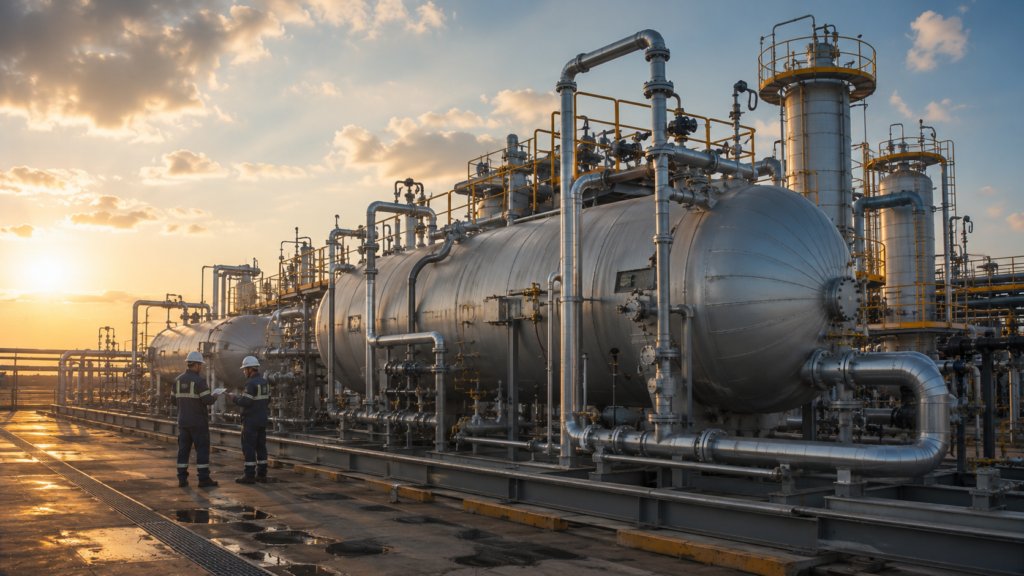
Small changes in internal geometry can significantly improve flow performance and reduce hydraulic losses.
We support optimization of:
This helps improve flow stability, reduce pressure losses, and enhance equipment reliability.

Experiqs helps oil and gas operators, EPC teams, and process equipment manufacturers address flow optimization challenges, including:
Optimize internal flow behaviour to improve equipment effectiveness, process stability, and operating output.
Identify and correct dead zones, recirculation, poor mixing, and uneven flow distribution.
Reduce hydraulic losses across equipment, piping, valves, manifolds, and process flow paths.
Improve flow delivery, reduce energy demand, and support more efficient process operation.
Identify unstable flow regions, high-velocity zones, and flow behaviour that may affect equipment integrity.
Use CFD simulation to compare design modifications before manufacturing, retrofit, or field implementation.
Our CFD-Based Process Flow Optimization service is suitable for:
Experiqs combines CFD simulation, process flow analysis, pressure drop evaluation, multiphase flow understanding, and engineering design optimization to improve oil and gas process system performance.
Our strength lies in identifying internal flow problems that are difficult to detect through physical inspection or basic measurements. We help clients understand where flow becomes uneven, where pressure losses occur, and how equipment geometry or operating conditions can be improved.
By validating process flow improvements virtually before implementation, Experiqs helps teams reduce operational risk, improve efficiency, enhance safety, and make better engineering decisions.
Improve internal flow behaviour, reduce maldistribution, lower pressure drop, and enhance process system efficiency with Experiqs’ CFD-Based Process Flow Optimization services.
Talk to our experts to evaluate your process system and identify practical opportunities for smoother flow, better reliability, and improved operating performance.
Partner with Experiqs to transform complex ideas into validated, industry-ready engineering solutions
Discover how to partner with Experiqs and get started quickly
Whether you’re exploring a new R&D initiative, seeking advanced simulations, planning experimental validation, or evaluating product feasibility—our experts are ready to assist you.
