Permanent magnets drive the heart of modern electrification. They are essential in electric vehicle motors, wind turbine generators, industrial equipment, robotics, data center systems, and high-end consumer electronics. As global demand surges, the heavy reliance on rare earth elements-particularly neodymium and dysprosium, with supply chains heavily concentrated in China- creates vulnerability around cost, geopolitics, and sustainability.
Iron nitride (α”-Fe₁₆N₂) offers a compelling rare-earth-free alternative. Minnesota-based Niron Magnetics is commercializing this technology, positioning it as the first new major permanent magnet material class in roughly 40 years. Built from abundant iron and nitrogen, it promises strong performance, improved supply chain security, and meaningful environmental benefits.

A picture of Iron nitride magnets
(*https://www.linkedin.com/pulse/iron-nitride-magnets-promising-alternative-rare-earth-james-murphree-oezpc)
The Science Behind the Material
The star performer is the α”-Fe₁₆N₂ phase, a tetragonal crystal structure first identified in the 1950s. What makes it special is its exceptionally high theoretical saturation magnetization-potentially reaching 2.4 T or higher, surpassing the typical 1.4–1.6 T of commercial NdFeB magnets. This “giant” magnetization comes from nitrogen atoms strategically distorting the iron lattice, boosting the magnetic moment per iron atom.
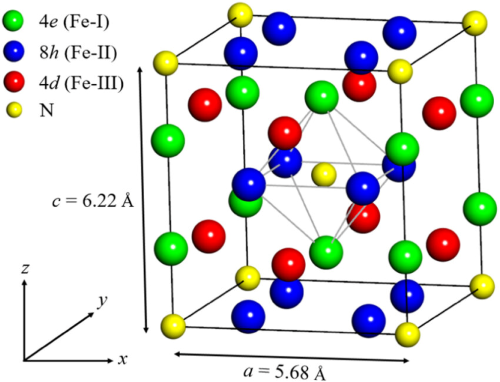
Structure of the Fe16N2 crystal
Additional advantages include inherently better temperature stability. The material shows a much lower temperature coefficient of coercivity than NdFeB, which could reduce or eliminate the need for heavy rare earth additives in many applications. Because it uses common, non-toxic inputs like iron powder and nitrogen (or ammonia), it sidesteps the environmental and ethical concerns tied to rare earth mining.
Niron’s innovation lies in nanocrystalline engineering. The company produces single-domain iron nitride nanoparticles with precise control over size, purity, and alignment. These particles are consolidated into bulk magnets—initially using binders and pressing, with longer-term goals of denser, higher-performance methods. High alignment delivers excellent squareness (reported up to 90% in pressed samples), which improves resistance to demagnetization.
Performance
In practice, iron nitride excels in high magnetization and thermal behavior but currently lags in coercivity compared to premium NdFeB grades. This means it may not serve as a universal drop-in replacement for the most demanding high-temperature or high-coercivity applications without motor redesigns. However, its higher flux density can enable smaller, lighter, or more efficient designs in many cases, while its resistivity (reportedly much higher than sintered NdFeB) benefits motor efficiency by reducing eddy current losses.
The α″ phase is metastable, so processing must avoid high temperatures that cause decomposition. Niron’s low-temperature, nanoparticle-based route addresses this historical challenge. Real-world bulk performance continues to improve as manufacturing scales.
Commercial Progress and Applications
Niron has advanced steadily from laboratory work to real production. They operate a commercial pilot plant in Minneapolis and have broken ground on a 1,500 tons-per-year full-scale facility in Sartell, Minnesota. Site selection is underway for a much larger ~10,000 tons-per-year plant.
- Demonstrated and targeted uses include:
- EV traction motors and other automotive applications
- Industrial motors, pumps, and compressors
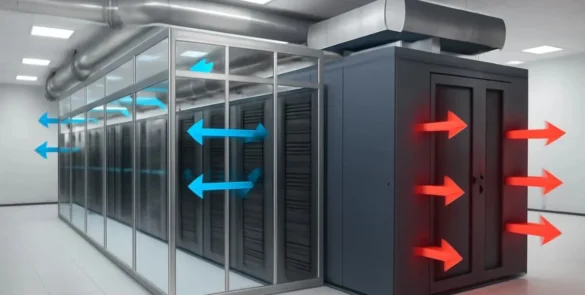
- Data center cooling systems
- Robotics and defense equipment
- High-end audio
These applications benefit from the material’s combination of high magnetization, cost potential, and domestic supply chain advantages—especially important for strategic sectors.
Challenges and Realistic Outlook
No new material is without hurdles. Key challenges for Fe16N2 include:
- Maintaining phase stability during scale-up
- Further boosting coercivity through powder engineering and processing
- Achieving consistent high performance in high-volume production
- Adapting motor and device designs to leverage its strengths (higher magnetization, better thermal coefficient) while working around moderate coercivity
It is particularly well-suited for applications operating below ~150–200°C where maximum energy product and cost/security matter more than extreme demagnetization resistance. Other rare-earth-free candidates like MnBi or tetrataenite are in development, but iron nitride’s magnetization potential gives it a strong position if manufacturing hurdles are cleared.
Why This Matters for Materials Science
This development highlights several exciting themes in contemporary materials engineering: precise nanostructure control to unlock bulk properties, sustainable metallurgy using earth-abundant elements, and the need for co-design between new materials and electromagnetic systems. Success here could ease pressure on rare earth supplies while enabling broader electrification.
Niron’s progress shows a disciplined path from university research (notably Prof. Jian-Ping Wang’s work at the University of Minnesota) to pilot production and multi-thousand-ton ambitions. While not yet a complete replacement for NdFeB in every niche, iron nitride has genuine potential to capture meaningful market share in cost-sensitive, high-volume, and strategically important applications.