Metal 3D printing has moved from prototypes to flight hardware in India. The winners will be the teams that predict stress and distortion before the laser fires.
A few years ago, metal additive manufacturing in India was largely a prototyping story. Today it is building rocket engines. ISRO’s PS4 engine, redesigned for laser powder bed fusion, combined 14 components into a single part, removed 19 weld joints and cut the raw material required from 565 kg to under 14 kg, according to Indian additive manufacturing industry coverage this year. Space startups are designing whole engines around printed parts, and defence and aerospace suppliers are following.
The question for engineering teams is no longer whether a part can be printed. It is whether it can be printed right the first time, every time.
Why metal parts fail in the printer
Metal printing is a thermal process at its core. A laser or electron beam melts a thin layer of powder, which solidifies and cools almost immediately, before the next layer is melted on top. Every point in the part goes through hundreds or thousands of rapid heating and cooling cycles.
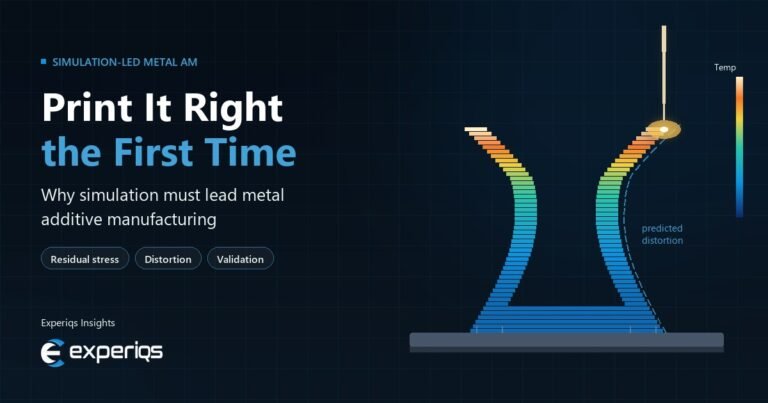
Those cycles leave their mark. Material that expands while hot and contracts while cooling, constrained by the solid metal beneath it, builds up residual stress. That stress can warp thin walls, lift parts away from support structures, open cracks, or simply shift a critical surface out of tolerance. Often the problem only becomes visible when the part is removed from the build plate, many hours after printing began.
The cost of finding out late
For simple brackets, a failed build is an inconvenience. For high-value aerospace parts, it is a serious loss: machine time measured in days, expensive alloy powder, post-processing effort, and a schedule that slips with every attempt. Trial and error also makes qualification harder, because each change to orientation, supports or process parameters can change how the part behaves.
This is why industry commentary this year has emphasised that simulation must be built into design, qualification and process optimisation, not treated as an afterthought once problems appear.
What simulation-led AM looks like
A simulation-led workflow starts before the first layer is printed. Three questions guide it.
First, is the design suited to the process? Topology and lattice optimisation can remove material where it is not needed, but the resulting shapes must also be printable without excessive supports or overhangs that trap heat.
Second, how will this part behave during the build? Thermo-mechanical simulation of the printing process predicts how temperature, stress and distortion develop layer by layer. Engineers can then adjust build orientation, support strategy and scan parameters, or pre-compensate the geometry so the part distorts into the right shape rather than out of it.
Third, will the finished part perform? Structural analysis of the printed part, using material behaviour that reflects the printed microstructure and any residual stress, confirms that it will carry its loads, survive fatigue and meet its safety margins.
Closing the loop with experiments
Simulation is only as trustworthy as its validation. The most effective programmes print carefully chosen test geometries, measure their distortion and properties, and use those results to calibrate the models. Once calibrated, the same models can be applied with confidence to new parts and new machines, cutting the number of physical iterations and giving qualification teams a clear evidence trail.
Validation also captures what models alone can miss. Feedstock consistency, for example, is often underestimated: two batches of nominally identical powder can behave differently in the melt pool. Measured data from test builds keeps the models honest, and keeps engineers alert to the variables that matter on their own machines, with their own materials. Over time, every build becomes a source of data that improves the next prediction rather than a one-off experiment.
How Experiqs helps
At Experiqs, our work in finite element analysis, materials behaviour and structural simulation is aimed at exactly this challenge. We help engineering teams design parts for the process, predict residual stress and distortion before printing, assess structural performance of printed components, and link those predictions to experimental validation. The aim is fewer failed builds, faster qualification, and parts that perform as designed.
Looking ahead
As India’s aerospace, space and defence programmes move printed parts into serial production, the gap between teams that print by trial and error and teams that print by prediction will only widen. Simulation is how metal additive manufacturing becomes predictable, repeatable and affordable.
If your team is scaling up metal 3D printing, or struggling with a part that will not print the way it should, we would be glad to talk. Reach out to the Experiqs team.
Sources: Manufactur3D, 3D printing in Indian aerospace (May 2026, updated Jul 2026); Australian Manufacturing via Pulse, Metal AM simulation after the first wave (30 Apr 2026)