
More results...
More results...
Many engineering systems involve simultaneous heat transfer through solid components and the surrounding fluid. For example, heat generated by an electronic chip is conducted through the heat sink and then removed by airflow, while a heat exchanger transfers heat through solid walls into a flowing liquid. Conjugate Heat Transfer (CHT) Simulation enables engineers to evaluate these coupled thermal interactions before manufacturing or product validation.
At Experiqs, we perform Conjugate Heat Transfer (CHT) Simulations to analyze the combined effects of conduction in solids and convection within fluids under realistic operating conditions. These simulations help engineers optimize cooling performance, improve thermal management, and validate engineering designs across industries where efficient heat dissipation is critical.
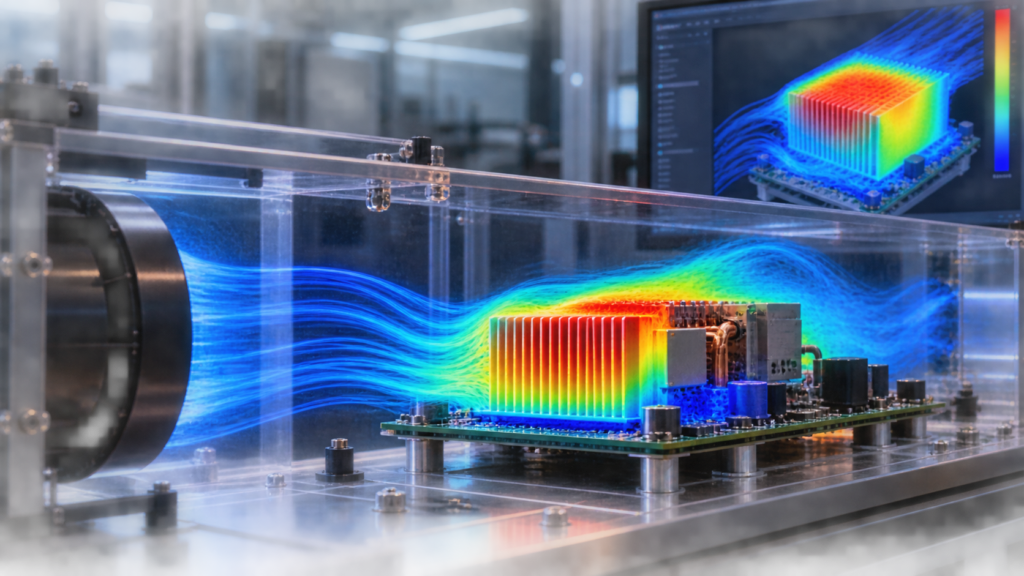

Many thermal systems cannot be accurately analyzed by studying solids or fluids independently. The interaction between both domains determines temperature distribution, cooling effectiveness, thermal efficiency, and product reliability. Simplified thermal analyses may overlook these interactions, leading to inaccurate predictions and suboptimal designs.
Conjugate Heat Transfer Simulation enables engineers to evaluate the complete thermal behaviour of a system by simultaneously analyzing heat conduction through solid materials and convective heat transfer within surrounding fluids. This provides a more realistic representation of operating conditions while reducing the need for repeated prototype testing.
Our conjugate heat transfer simulation capabilities support the evaluation of coupled thermal behaviour across engineering products and industrial systems. These analyses help engineers investigate heat flow between solids and fluids, optimize cooling performance, improve thermal efficiency, and validate engineering designs before implementation.
Conjugate Heat Transfer Simulations are widely applied across electronics cooling, battery systems, heat exchangers, automotive powertrains, aerospace components, industrial equipment, HVAC systems, energy systems, medical devices, and consumer electronics where heat transfer between solids and fluids directly influences performance and reliability.
Depending on the project requirements, clients may receive:
Whether you’re optimizing cooling systems, evaluating heat transfer between solids and fluids, improving thermal management, or validating product performance under operating conditions, our engineers can help identify the appropriate Conjugate Heat Transfer simulation approach for your application.

Partner with Experiqs to transform complex ideas into validated, industry-ready engineering solutions
Discover how to partner with Experiqs and get started quickly
Whether you’re exploring a new R&D initiative, seeking advanced simulations, planning experimental validation, or evaluating product feasibility—our experts are ready to assist you.
Whether you’re exploring a new R&D initiative, seeking advanced simulations, planning experimental validation, or evaluating product feasibility—our experts are ready to assist you.
