
More results...
More results...
Automotive manufacturing requires high precision, repeatability, process control, and quality assurance across forming, welding, joining, heat treatment, curing, painting, assembly, and inspection operations. Even small process variations can create defects, deformation, dimensional mismatch, weak joints, surface quality issues, rework, scrap, and production delays.
Manufacturing & Process Engineering helps automotive and electric mobility teams improve production processes using simulation, computer vision, and process optimization. By evaluating forming feasibility, weld performance, thermal distortion, airflow behaviour, assembly quality, and defect detection methods, Experiqs helps manufacturers improve reliability, reduce defects, and support faster production decisions.
Experiqs provides Manufacturing & Process Engineering services for automotive OEMs, EV manufacturers, mobility startups, component suppliers, fabrication teams, and production engineering teams. We use forming analysis, welding and joining simulation, thermal process modelling, CFD airflow analysis, computer vision, defect detection, deformation tracking, and process optimization to improve manufacturing quality and efficiency.
Automotive manufacturing processes must balance quality, speed, cost, and repeatability. Forming operations must avoid tearing, wrinkling, springback, and dimensional errors. Welding and joining processes must deliver adequate strength while controlling distortion, residual stress, and heat-affected zone behaviour. Thermal processes such as heat treatment, curing, and paint drying must maintain uniform temperature and stable airflow.
In EV manufacturing, additional challenges arise from battery pack assembly, lightweight structures, thermal interfaces, electronic enclosures, joining of dissimilar materials, sealing quality, and dimensional control. Poor process control can affect safety, durability, thermal performance, and product quality.
Traditional trial-and-error process improvement can be slow and expensive. Simulation-led process engineering helps predict deformation, thermal distortion, weld behaviour, airflow patterns, and manufacturing risks before changes are implemented on the production line.
Computer vision and inline inspection support faster defect detection, surface inspection, deformation tracking, and quality monitoring. Experiqs helps automotive teams connect simulation, process engineering, and intelligent inspection to improve manufacturing outcomes.
We study forming feasibility, weld performance, joining strength, deformation risk, and assembly quality for automotive components and structures.
Our analysis helps assess:
This helps improve manufacturing feasibility and reduce production defects.

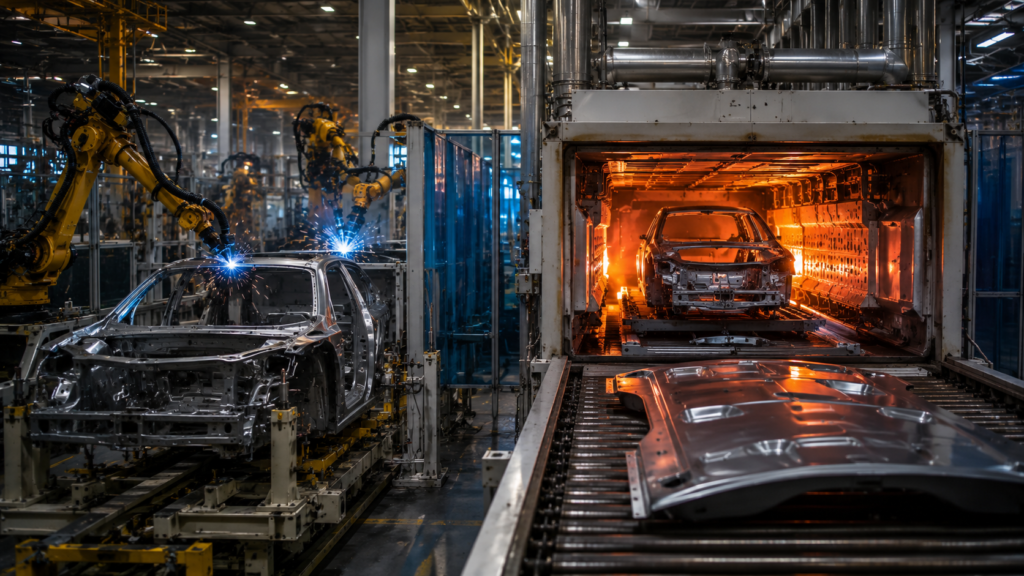
We evaluate welding, heat treatment, curing, paint-booth airflow, and thermal distortion behaviour during manufacturing processes.
We help analyze:
This helps reduce thermal defects, improve process consistency, and support better production quality.
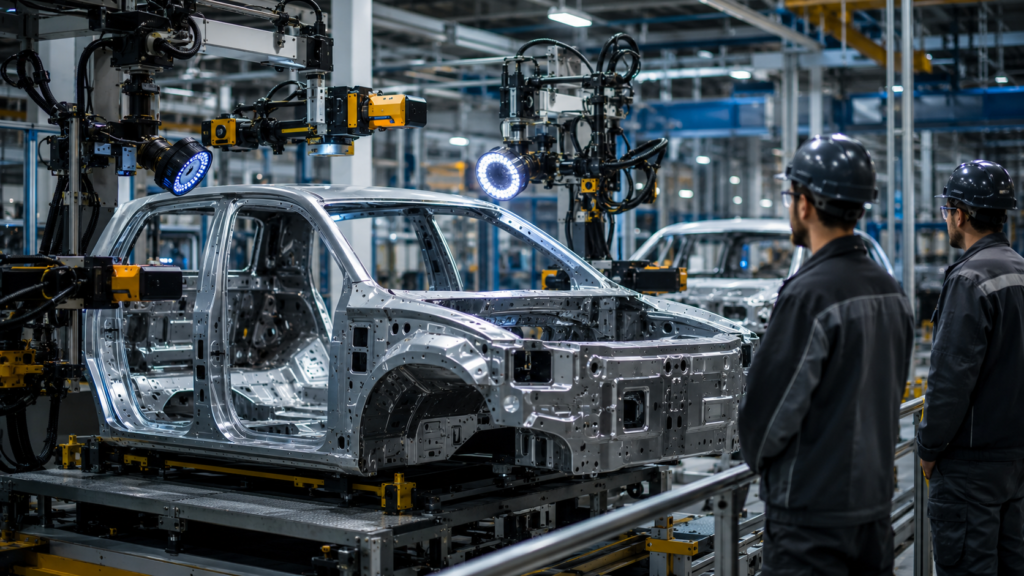
We use computer vision to support defect detection, deformation tracking, surface inspection, and production quality monitoring.
Experiqs supports:
This helps improve inspection speed, consistency, and defect visibility across production lines.
Paint quality, curing performance, and contamination control depend strongly on airflow behaviour and thermal uniformity.
We help evaluate:
This helps improve coating quality, reduce defects, and support energy-efficient process operation.

Assembly quality depends on part fit, tolerance control, joining sequence, fixture behaviour, and deformation during manufacturing.
We help assess:
This helps improve assembly consistency and reduce manufacturing quality issues.

Manufacturing processes can often be improved by identifying the root cause of defects and testing changes virtually before line implementation.
We support optimization of:
This helps reduce defects, improve process stability, and support cost-efficient production.
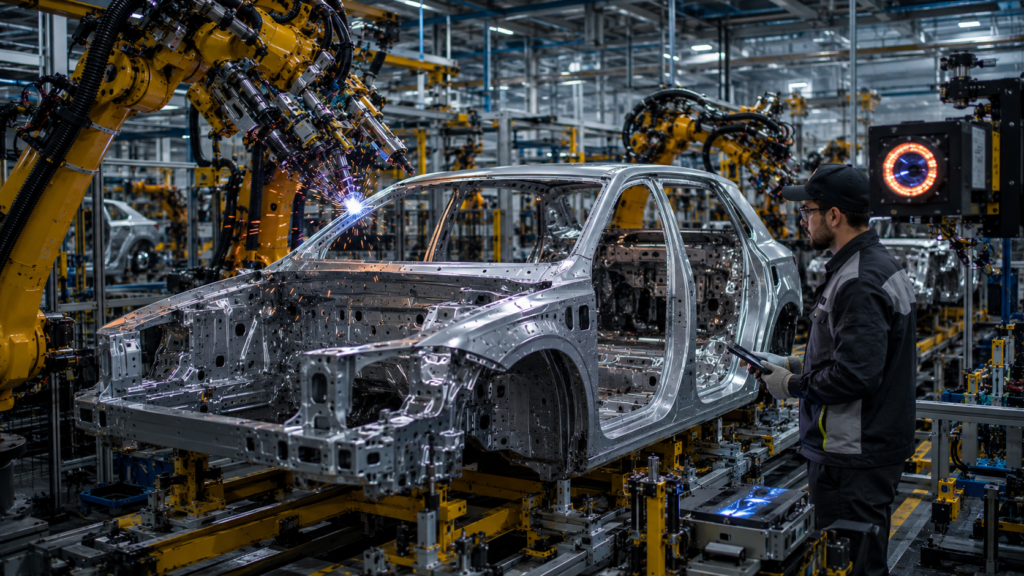
Experiqs helps automotive OEMs, EV manufacturers, component suppliers, and production teams address manufacturing and process challenges, including:
Identify process risks early and reduce defects related to forming, welding, joining, thermal distortion, and assembly variation.
Evaluate process conditions, thermal behaviour, airflow patterns, and deformation risks to improve repeatability.
Use computer vision support for surface inspection, deformation tracking, weld inspection, and inline quality monitoring.
Identify root causes of manufacturing defects and validate improvements before implementation.
Improve manufacturing reliability for battery enclosures, lightweight structures, thermal components, and electronic housings.
Use simulation and data-driven inspection insights to improve process design, quality control, and production efficiency.
Experiqs combines simulation, manufacturing engineering, CFD, thermal analysis, structural assessment, computer vision, and process optimization expertise to improve automotive and EV production quality.
Our strength lies in connecting product design with real manufacturing behaviour. We help clients understand why defects occur, how process parameters affect quality, and which improvements can reduce rework, scrap, and production risk.
By validating manufacturing processes virtually and supporting intelligent inspection, Experiqs helps automotive teams improve quality, reduce development delays, strengthen production reliability, and make better process engineering decisions.
Optimize forming, welding, joining, thermal processes, paint-booth airflow, inline inspection, and production quality monitoring with Experiqs’ Manufacturing & Process Engineering services.
Talk to our experts to evaluate your manufacturing process and identify practical opportunities for better quality, lower defects, improved repeatability, and stronger production efficiency.
Partner with Experiqs to transform complex ideas into validated, industry-ready engineering solutions
Discover how to partner with Experiqs and get started quickly
Whether you’re exploring a new R&D initiative, seeking advanced simulations, planning experimental validation, or evaluating product feasibility—our experts are ready to assist you.
