CO₂ emissions in cement manufacturing arise from two different sources: the fuel combustion required to generate very high process temperatures, and the calcination of limestone, where calcium carbonate decomposes into calcium oxide and CO₂. Cement and concrete production is commonly estimated to contribute around 7–8% of global CO₂ emissions, and decarbonisation therefore requires a combination of fuel switching, clinker reduction, alternative raw materials, carbon capture and process optimisation.
Hydrogen combustion is being considered as one route to reduce the fuel-related emissions from cement kilns and calciners. It can reduce or eliminate fuel-derived CO₂, however, it cannot remove the process CO₂ released during limestone calcination. This makes hydrogen a useful but partial decarbonisation pathway, especially when combined with biomass, refuse-derived fuel, carbon capture and storage, and lower-clinker cement formulations.
1. Why hydrogen is relevant to cement manufacturing
Cement production requires sustained high-temperature heat. In a typical clinker production line, raw meal passes through a preheater, calciner and rotary kiln before being cooled as clinker. The main reactions include drying, preheating, calcination and high-temperature clinker mineral formation. Clinker formation requires temperatures of approximately 1,450°C, while flame temperatures in the burner zone can be significantly higher.
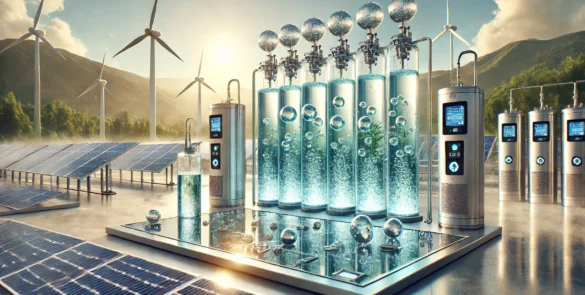
Hydrogen is attractive because its combustion produces water vapour rather than CO₂ at the point of use. When produced from low-carbon electricity or other low-emissions pathways, hydrogen can therefore reduce the direct fossil CO₂ emissions associated with coal, petcoke, natural gas or other conventional fuels.
Hydrogen can be applied in cement manufacturing in several ways:
- Co-firing with conventional fuels
Hydrogen can be blended with coal, petcoke, natural gas or fuel oil to gradually reduce fossil carbon intensity. This is a practical near-term route because it avoids a sudden full conversion of the kiln system.
- Co-firing with alternative fuels
Hydrogen can also be used alongside RDF, biomass, waste-derived fuels, sewage sludge, tyres or other alternative fuels. In this role, hydrogen can act as a combustion stabiliser because it has high flame speed, wide flammability limits and fast ignition characteristics.
- Calciner injection
The calciner consumes a significant portion of the total thermal energy in modern cement plants. Hydrogen injection into the calciner can support fuel substitution, improve ignition of alternative fuels and help maintain stable temperature fields.
- Main burner injection
Hydrogen can be injected through dedicated lances or modified multi-channel burners at the rotary kiln main burner. This directly affects flame shape, flame momentum, radiation, clinker bed heating and NOx formation.
2. Co-firing hydrogen with RDF, biomass and other alternative fuels
Alternative fuels are already widely used in cement plants to reduce fossil fuel dependency and lower waste disposal impacts. RDF and biomass are among the most important candidates. However, these fuels are much more variable than conventional pulverised coal or natural gas.
RDF may contain plastics, paper, textiles, wood, rubber, inert material and moisture. Its particle size, calorific value, ash content and volatile fraction can vary significantly from batch to batch. Biomass fuels such as wood chips, sawdust, agricultural residues or pellets are renewable, but they also vary in moisture content, volatile matter, ash chemistry and burnout behaviour.
Hydrogen can support these fuels in several ways:
- It can improve ignition of low-grade or high-moisture alternative fuels.
- It can stabilise flames when RDF or biomass composition fluctuates.
- It can compensate for delayed devolatilisation or slow char burnout.
- It can reduce fossil fuel demand while allowing high alternative-fuel substitution.
- It can help maintain temperature levels in the calciner or main burner zone.
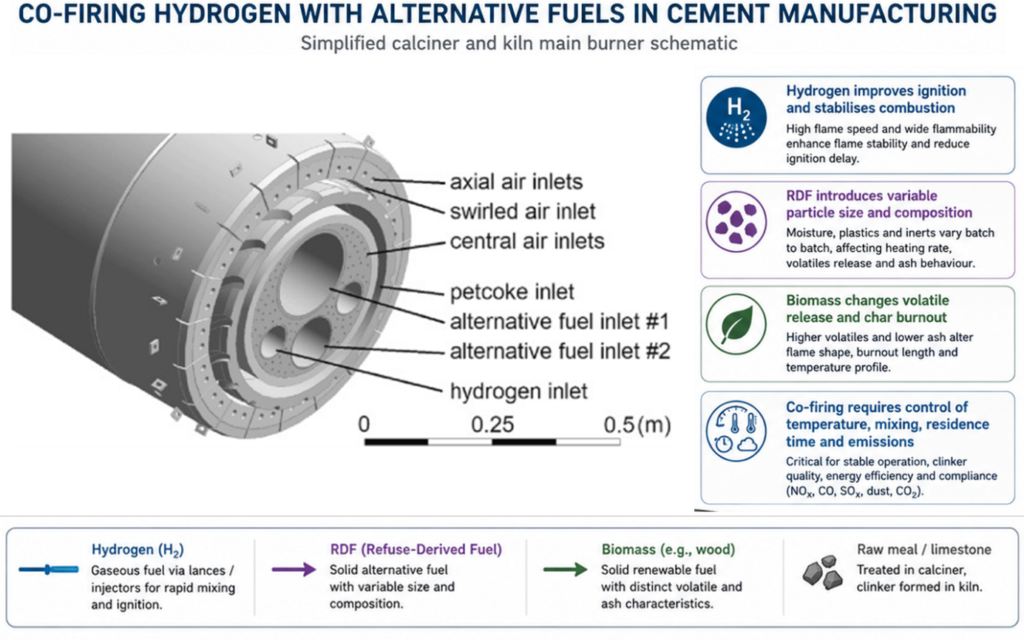
Figure 1. Hydrogen can be injected through lances or burner channels while RDF and biomass are introduced as solid alternative fuels.
Research on multi-fuel cement burners has shown that high shares of alternative fuels such as RDF and biomass can be co-fired without major combustion-performance penalties under appropriate operating conditions, and that hydrogen addition can improve combustion characteristics.
This makes hydrogen particularly interesting not only as a direct fossil-fuel substitute, but also as an enabling fuel for higher alternative-fuel substitution rates.
3. Advantages of hydrogen combustion in cement manufacturing
3.1 Reduction of fuel-derived CO₂ emissions
The most important advantage of hydrogen is that it produces no direct CO₂ during combustion. If green or low-emissions hydrogen replaces coal, petcoke or natural gas, the fossil carbon contribution from kiln fuel can be significantly reduced.
This is especially relevant because the cement sector’s decarbonisation pathway includes low-carbon fuels, lower clinker-to-cement ratios and carbon capture for residual CO₂ emissions.
3.2 Suitability for high-temperature heat
Cement kilns require high-temperature, continuous and controllable heat. Hydrogen combustion can provide the required thermal intensity, making it more compatible with existing kiln-based clinker production than some lower-temperature heat alternatives.
3.3 Support for alternative-fuel combustion
Hydrogen can help stabilise combustion when alternative fuels are variable, wet or slow-burning. This is especially useful for RDF and biomass, where inconsistent particle size and composition can lead to unstable flame behaviour, incomplete burnout, CO formation or local temperature fluctuations.
3.4 Improved operational flexibility
Hydrogen can be used as a fast-response fuel to support flame stability, ignition and temperature control during changes in RDF or biomass quality. This makes it useful not only for emissions reduction, but also for process control.
4. Limitations and technical challenges
4.1 Hydrogen does not remove calcination CO₂
This is the fundamental limitation. Even if the kiln were fired entirely with green hydrogen, limestone calcination would still release CO₂. Therefore, hydrogen combustion alone cannot make cement production net zero.
A credible net-zero route must combine hydrogen or other low-carbon fuels with measures such as clinker substitution, alternative raw materials, carbon capture, supplementary cementitious materials and process optimisation.
4.2 NOx formation risk
Hydrogen flames can produce high local temperatures. In air-fired systems, this can increase thermal NOx formation because nitrogen and oxygen from combustion air react more readily at elevated temperatures.
This is a major concern in cement kilns, where temperatures are already high. Hydrogen firing therefore requires careful burner design, staged combustion, air distribution control, possible flue gas recirculation and NOx monitoring.
4.3 Changes in flame shape and heat transfer
Hydrogen has different combustion properties from coal, petcoke, RDF or biomass. It has high diffusivity, fast reaction rates and low volumetric energy density. These properties can produce a flame that is shorter, hotter or more intense if not properly controlled. In a cement kiln, this matters because flame shape determines clinker bed heating, refractory exposure, coating stability, kiln thermal profile and clinker mineral formation.
4.4 Fuel supply, storage and safety
Cement plants require large and continuous energy flows. Supplying enough low-carbon hydrogen would require significant infrastructure, including production, compression, storage, transport, metering, safety systems and modified burners.
The IEA’s 2025 hydrogen review notes that low-emissions hydrogen still represents a very small share of global hydrogen production, which limits near-term availability for large industrial users.
4.5 Cost competitiveness
Hydrogen remains more expensive than many conventional and alternative cement kiln fuels. Its viability depends on hydrogen price, carbon price, policy support, renewable electricity cost, plant location and access to hydrogen hubs or industrial clusters.
5. Viability of hydrogen combustion for cement decarbonisation
Hydrogen combustion is technically viable, but its economic and practical viability depends strongly on local conditions.
It is most viable where:
- low-carbon hydrogen is available at industrial scale;
- the cement plant is located near hydrogen infrastructure;
- carbon pricing or policy incentives support fuel switching;
- RDF, biomass or other alternative fuels are already used;
- burner systems can be modified for multi-fuel operation;
- carbon capture is planned for process CO₂.
In the near term, hydrogen is more likely to be used as a co-firing and combustion-support fuel rather than as a complete replacement for all kiln fuel. Its strongest role may be in helping plants increase alternative-fuel substitution while maintaining flame stability, clinker quality and emissions compliance.
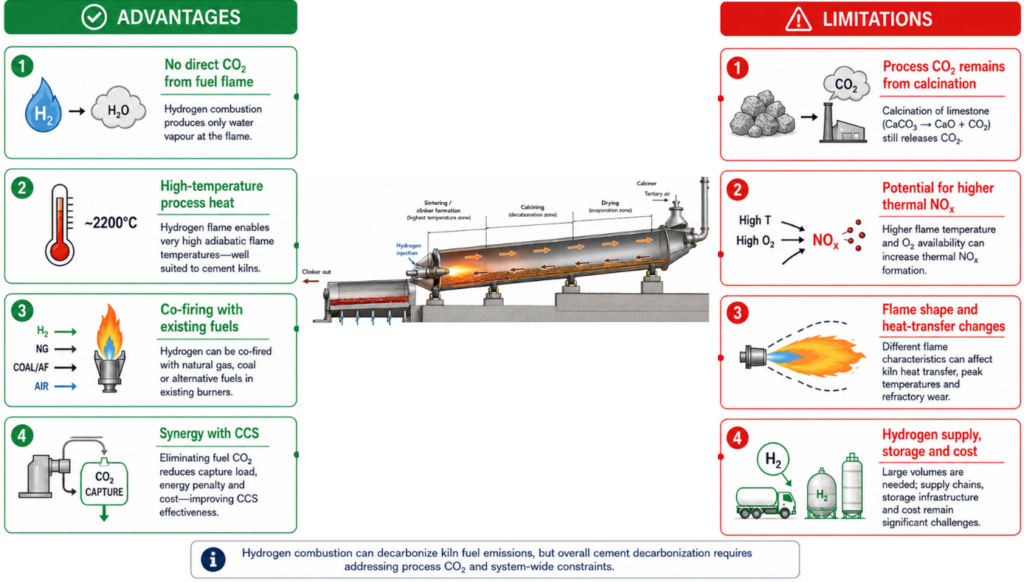
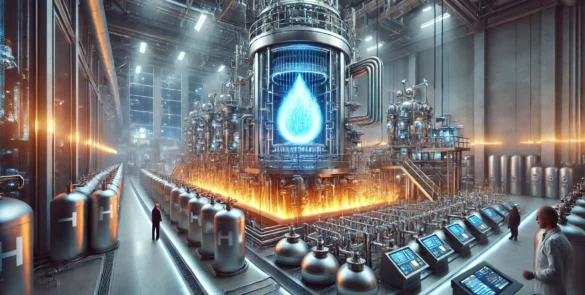
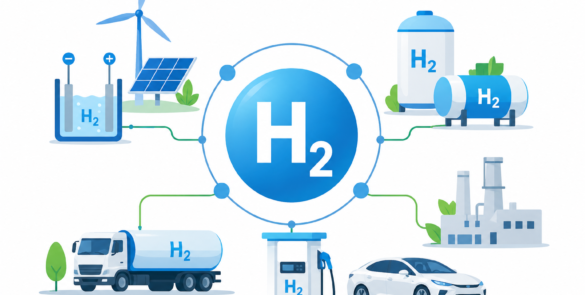
Figure 2. Overall view of hydrogen combustion as decarbonisation strategy for cement industries
6. Role of CFD simulations in hydrogen combustion and co-firing analysis
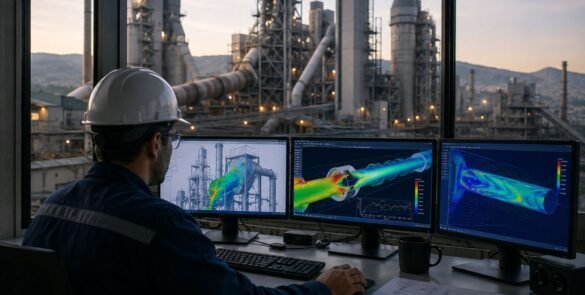
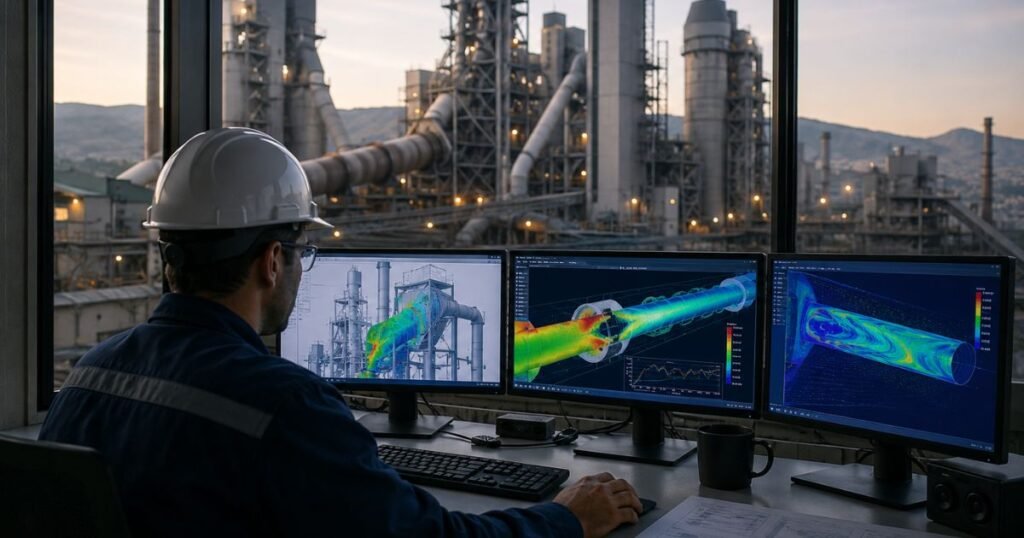
Computational fluid dynamics is one of the most important engineering tools for evaluating hydrogen combustion in cement manufacturing. Cement kilns and calciners involve turbulent reacting flow, radiative heat transfer, particle transport, devolatilisation, char burnout, calcination, rotating geometry, refractory heat transfer and complex gas-solid interactions. CFD allows engineers to test fuel strategies virtually before making expensive and risky changes to the plant.
CFD has already been used in cement rotary kiln and burner studies to predict flame temperature, velocity fields, flame stability, fuel and oxidant composition, emissions and calcination reactions. It has also been applied to cement kiln co-combustion studies involving RDF, biomass and other waste-derived fuels.
6.1 Flame structure and hydrogen injection design
CFD can analyse how hydrogen injection affects:
- flame length;
- flame lift-off;
- recirculation zones;
- ignition position;
- burner momentum;
- jet penetration;
- mixing with primary, secondary and tertiary air.
This is critical because hydrogen can burn rapidly and may change the flame from a long radiative solid-fuel flame to a shorter, more intense flame. CFD helps determine whether hydrogen should be injected through a central lance, annular channel, multiple side lances or staged injection points.
6.2 Multi-fuel interaction between hydrogen, RDF, biomass and air
The most valuable CFD application is not modelling hydrogen alone but modelling the interaction between multiple fuel streams. In a real kiln or calciner, hydrogen, RDF, biomass, coal, petcoke, primary air, secondary air and tertiary air may all interact. CFD can evaluate:
- whether the fuel streams mix properly;
- whether oxygen is available where solid fuel burnout is needed;
- whether RDF or biomass particles bypass the hottest zone;
- whether hydrogen shifts the heat-release zone too close to the burner;
- whether staged air reduces NOx without increasing CO;
- whether local reducing zones affect clinker chemistry;
- whether the kiln inlet or calciner develops build-up risk.
This type of analysis is especially important when increasing alternative-fuel substitution rates, because poor mixing can lead to CO peaks, incomplete burnout, unstable calcination and operational instability.
6.3 Temperature profile and clinker quality
Cement production requires not just high heat, but the correct thermal history. CFD can predict gas temperature, wall heat flux, clinker bed heating and burning-zone thermal distribution.
For hydrogen and alternative-fuel co-firing, this helps answer key process questions:
- Is the burning zone temperature sufficient for clinker formation?
- Is heat release occurring too early or too late?
- Are refractory walls exposed to excessive peak temperatures?
- Is the clinker bed receiving enough radiative heat?
- Could altered flame shape affect alite formation and cement strength?
CFD results can be coupled with thermochemical or process models to estimate impacts on calcination degree, clinker mineralogy and overall kiln stability.
6.4 NOx, CO and emissions prediction
Hydrogen can increase thermal NOx due to high flame temperature, while RDF and biomass can increase CO if burnout is incomplete. Biomass and RDF may also influence SOx, HCl, alkalis, heavy metals, dust and ash behaviour depending on composition.
CFD can help evaluate:
- thermal NOx formation zones;
- fuel-NOx contribution from nitrogen-containing fuels;
- CO pockets from incomplete alternative-fuel burnout;
- effect of excess air ratio;
- impact of staged combustion;
- influence of flue gas recirculation;
- oxygen availability near RDF and biomass particles.
This makes CFD valuable for balancing three competing objectives: high alternative-fuel substitution, stable clinker quality and regulatory emissions compliance.
6.5 Burner and calciner retrofit assessment
Hydrogen integration often requires retrofit decisions. CFD can compare several design options before physical modification, including:
- dedicated hydrogen lances;
- multi-channel burners;
- annular hydrogen injection;
- staged hydrogen injection;
- RDF and biomass feed relocation;
- modified tertiary air ducts;
- swirl adjustment;
- oxygen enrichment;
- flue gas recirculation.
This reduces trial-and-error at plant scale and helps avoid unsafe or inefficient operating conditions.
7. Conclusion
Hydrogen combustion can help decarbonise cement manufacturing, but it should be viewed as a fuel-side decarbonisation measure rather than a complete solution. Its main strength is replacing fossil heat in kilns and calciners. Its main limitation is that it does not address calcination CO₂. The strongest decarbonisation pathway will combine hydrogen with clinker substitution, low-carbon raw materials, alternative fuels, energy efficiency, carbon capture and process optimisation.
CFD simulation is a key enabler in this transition. By modelling flame behaviour, heat transfer, emissions, burner performance and clinker process impacts, CFD helps cement producers integrate hydrogen more safely, efficiently and reliably.