Space propulsion technology has always been a critical focus in the aerospace industry. With growing ambitions to make space travel more efficient and accessible, innovations in rocket propulsion have become crucial to overcoming existing challenges. One of the most promising developments in this area is the Aerospike nozzle, a revolutionary design that offers enhanced performance compared to traditional rocket nozzles. In this blog, we’ll explore what makes the Aerospike nozzle a game-changer and why it holds so much potential for the future of space exploration.
The Traditional Bell Nozzle: An Overview
For decades, rocket engines have relied on the Bell-shaped (Convergent-Divergent) nozzle to accelerate exhaust gases and generate the necessary thrust to propel spacecraft. The design is simple and effective, allowing for the expansion of hot gases from the combustion chamber into the atmosphere. However, this design has its drawbacks. One significant limitation is that the Bell nozzle is optimized for a single altitude, meaning its performance declines when operating outside its design conditions. As a result, multi-stage rockets are required to operate efficiently in various atmospheric conditions, significantly increasing the cost and complexity of space missions.
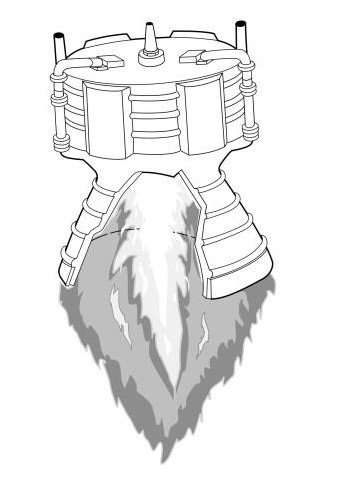
(a) Normal Bell Nozzle rocket engine
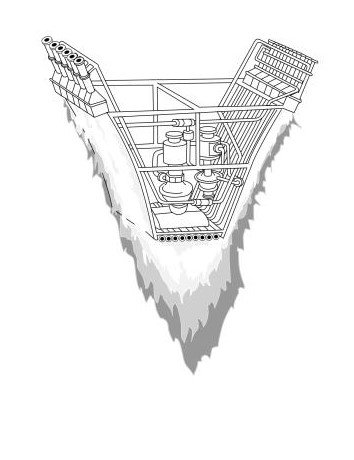
(b) Linear aerospike rocket engine
Figure 1: Comparison of a Normal Bell-Nozzle Rocket Engine and the X-33 Linear
Aerospike Rocket Engine (Dryden Flight Research Centre February 1998) .
Source: NASA:
As seen in the figure 1 above, the traditional Bell Nozzle has a fixed geometry, making it less adaptable to varying altitudes. On the other hand, the Aerospike nozzle (shown on the right) offers superior efficiency due to its altitude-compensating feature. This feature allows the Aerospike nozzle to adjust its performance based on changing atmospheric pressure, giving it a distinct advantage over Bell nozzles.
What is an Aerospike Nozzle?
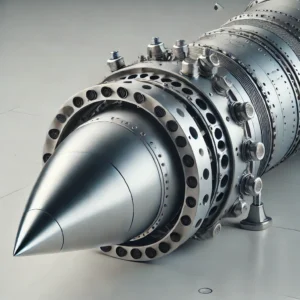
The Aerospike nozzle offers a solution to the limitations of traditional nozzles by providing an altitude-compensating feature. Unlike the Bell nozzle, which relies on the nozzle walls to guide the exhaust flow, the Aerospike nozzle uses the surrounding atmospheric pressure to control the expansion of exhaust gases. This enables the nozzle to continuously adjust its performance as the vehicle ascends, maintaining efficiency across a wide range of altitudes.
The key innovation of the Aerospike nozzle lies in its passive altitude compensation. Instead of confining the exhaust gases within a fixed structure, the nozzle allows the atmosphere to act as a virtual wall, dynamically shaping the exhaust plume to achieve optimal expansion at different altitudes. This adaptability makes Aerospike nozzles ideal for Single-Stage-to-Orbit (SSTO) missions, where a spacecraft must operate efficiently from launch through the vacuum of space without the need for multiple stages.
The Advantages of Aerospike Nozzles
- Altitude Adaptability: The primary advantage of Aerospike nozzles is their ability to adapt to changing atmospheric pressure, allowing them to maintain high efficiency across varying altitudes. This eliminates the need for complex multi-stage rockets, potentially reducing launch costs and simplifying vehicle design.
- Thrust Vectoring: Aerospike nozzles also offer thrust vectoring capabilities without the need for mechanical gimbaling systems. By controlling the exhaust flow directly, Aerospike nozzles can alter the direction of the thrust, providing precise control over the spacecraft’s trajectory. This capability is particularly valuable for spacecraft requiring high maneuverability.
- Reduced Drag: With a more streamlined design, Aerospike nozzles expose less surface area to atmospheric drag, resulting in reduced drag forces and improved overall efficiency. This makes them more aerodynamic than traditional Bell nozzles, especially during the early stages of ascent.
Historical Development of Aerospike Nozzles
The concept of Aerospike nozzles has been around for several decades. Research into this technology began in the 1960s with NASA and Rocketdyne, as part of an effort to explore alternative rocket nozzle designs that could improve performance over the conventional Bell nozzle. Early projects, however, were abandoned due to technological limitations and a lack of significant performance gains.
Interest in Aerospike nozzles was renewed in the 1990s during NASA’s X-33 VentureStar program, which aimed to develop a reusable spaceplane capable of SSTO flights. The program included the development of the XRS-2200 Linear Aerospike engine, a cutting-edge propulsion system designed to utilize Aerospike technology. Although the program was eventually canceled due to unrelated technical issues, the success of the Aerospike engine tests demonstrated the potential of the technology, spurring further research and development.
Today, renewed interest in single-stage reusable spacecraft and cost-effective space missions has brought Aerospike nozzles back into focus. As technological advances continue, the promise of Aerospike nozzles making SSTO flights a reality is closer than ever before.
Types of Aerospike Nozzles
Over time, several variations of the Aerospike nozzle have been developed, each tailored for specific applications. Below are the main types:
- Full-Length Plug Nozzle (LFPN): The traditional Aerospike design, featuring a long spike for maximum control over exhaust flow, ensuring high thrust efficiency at all altitudes.
Pros: Maximizes thrust efficiency.
Cons: Heavy, increasing the overall weight of the propulsion system. - Truncated Plug Nozzle (LTPN): A shortened version of the full-length spike, designed to reduce weight while maintaining many of the performance benefits.
Pros: Better thrust-to-weight ratio, lighter than the full-length version.
Cons: Can introduce base drag and flow separation at lower altitudes, though minimal. - Segmented or Clustered Aerospike Nozzle: Composed of multiple smaller nozzles clustered around a truncated spike, allowing for differential thrust vectoring.
Pros: Offers precise control over thrust and trajectory, ideal for maneuverability.
Cons: More complex, potentially increasing weight and system complexity.
Challenges in Aerospike Design
Despite the many advantages of Aerospike nozzles, they have yet to be widely adopted in real-world space missions. Several challenges must be overcome before they become a standard feature of rocket engines:
- Complexity of Manufacturing: The intricate geometry of Aerospike nozzles, particularly with truncated and clustered designs, makes them difficult to manufacture. The spike’s sharp edges and need to withstand extreme temperatures pose additional challenges.
- Base Drag and Flow Separation: In truncated designs, the absence of a full spike can cause base drag and flow separation at lower altitudes. These issues can reduce the nozzle’s overall efficiency and generate side loads, making the rocket harder to control.
- Thermal Management: The high temperatures generated by the exhaust gases expanding along the spike require advanced cooling systems to prevent the nozzle from degrading over time.
Conclusion
A Promising Future for Aerospike Nozzles Despite the challenges, Aerospike nozzles represent a significant leap forward in rocket propulsion technology. Their ability to passively adapt to changing altitudes, provide better thrust efficiency, and reduce the need for complex engine gimbals makes them an ideal choice for SSTO vehicles and future space missions. As research continues, Aerospike nozzles could become a key component in making space travel more efficient and cost-effective.